Course Content
Orientation
This course teaches employees how to create and manage strong, unique passwords to protect business accounts and data from unauthorized access. Participants learn best practices for building complex passwords, using password managers safely, and avoiding common mistakes like reuse or weak patterns. Understanding the importance of strong passwords helps reduce the risk of cyberattacks and data breaches caused by compromised credentials.
0/2
Passwords and Authentication
A strong password is one that is difficult for others — and even automated tools — to guess or crack. It should be at least 12 characters long and include a mix of uppercase and lowercase letters, numbers, and special symbols (like !, @, or #). Avoid using personal information such as names, birthdays, or common words, as these can be easily discovered through social media or brute-force attacks. Instead, create passwords using random combinations of unrelated words or phrases — for example, “Coffee!Tree4Ocean.” Password managers can also help by securely generating and storing complex passwords for each account. The key to password security is uniqueness: never reuse the same password across multiple systems.
0/6
Phishing and Email Threats
Phishing is a type of social-engineering attack where criminals pretend to be a trusted person or organisation to trick you into revealing sensitive information. This is a very common type of cyber-attack in today's world. As we go through this module we will learn how to identify and mitigate phishing attacks.
0/1
Social Engineering
Malware, Viruses & Ransomware
Safe Internet & Device Usage
Data Protection and Privacy
Physical Security
Protected: Security Awareness Training

Welcome to your first lesson for Cyber Security Awareness Training!


The core competency of this module:
The Understanding that the role of passwords can play in cybersecurity. Passwords are you first line of defense – it is important to understand how we can construct and utilize passwords to keep a strong security posture.

At the end of this module you should be able to:

  1. Understand why passwords matter
  2. Be able to develop strong passwords
  3. The dangers of password re-using 
  4. Password managers
  5. Two factor authentication


So why do passwords matter? 

Passwords are the first and often only barrier between attackers and your accounts, systems, and sensitive data.

A single compromised credential can give an attacker access to email, financial systems, HR records and admin tools –  and from there they can steal data, commit fraud, impersonate staff, or cause costly business disruption.

Because attackers automate and scale attacks, even small, everyday password mistakes (reuse, short words, predictable patterns) quickly become high-impact security failures.


Did you know? 

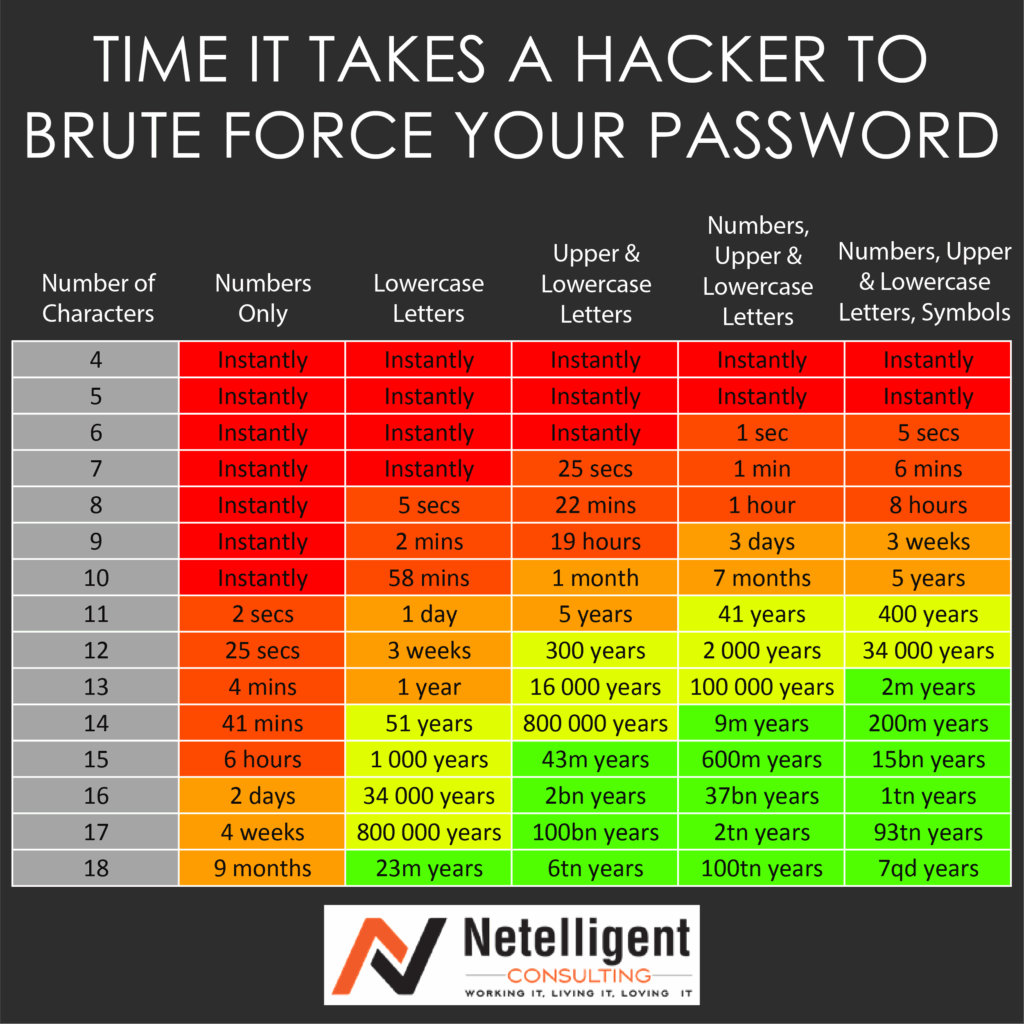
Weak passwords can be cracked within seconds! Take a look at the chart below to see how your strong current passwords are. 
 

Closing thoughts on password importance:

Strong, unique passwords reduce the chances that automated tools or simple guessing will grant attackers entry.

When combined with good practice tools (which we will be learning about in upcoming modules) such as password managers and MFA. We will greatly reduce the risk of attacks.